The Personalities Explained: Why You Think, Feel & Respond the Way You Do|(feat. Marita Tedder)|
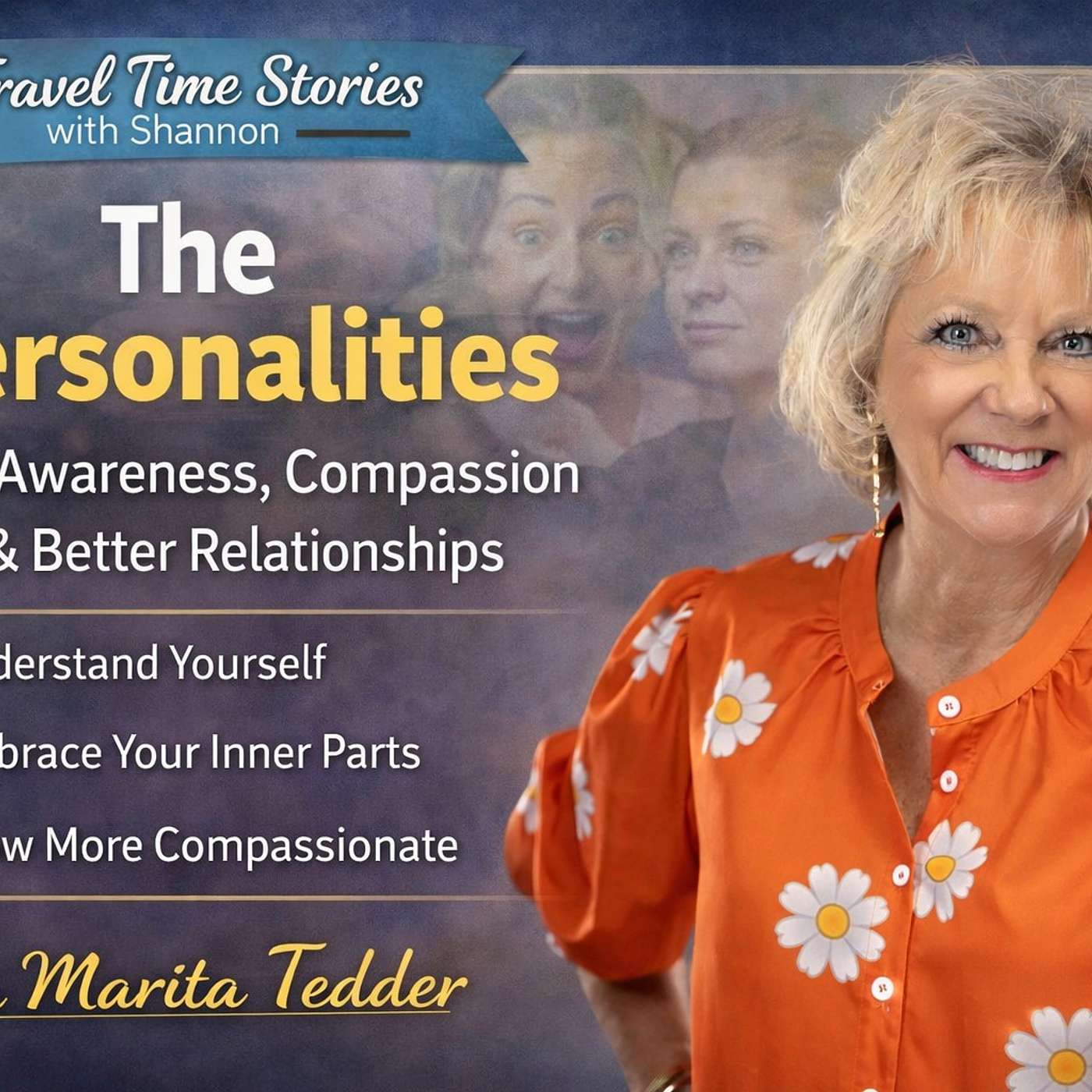



What if the very traits you’ve questioned about yourself are actually your greatest strengths?
In this episode of Travel Time Stories with Shannon, we sit down with Marita Tedder — author, speaker, and personality expert — to explore The Personalities and how understanding them can transform the way we see ourselves and others.
Growing up alongside her mother, renowned author Florence Littauer, Marita has spent over 50 years helping people understand the why behind their behaviors. This conversation goes beyond labels and dives into compassion, self-awareness, and healthier relationships.
In this episode, we discuss:
✨ What The Personalities are and how they work
✨ Why we react differently in relationships
✨ Common misconceptions about personality typing
✨ How focusing on strengths changes everything
✨ Living authentically instead of trying to “fix” yourself
✨ Building deeper compassion for others
This isn’t about putting yourself in a box — it’s about understanding how you’re wired so you can live with more intention, freedom, and connection.
If you’ve ever felt misunderstood…
If you’ve ever wondered why you and someone you love see the world so differently…
This episode will give you language, clarity, and hope.
🎧 Listen now and discover how self-awareness can lead to stronger relationships and a fuller life.
Marita's resources: https://thepersonalities.com/
#traveltimestorieswithshannon #personalitytypes #selfawarenessmatters #personalgrowth #healthyrelationships #emotionalintelligence #thepersonalities #maritatedder #podmatch #selfgrowth #selfdiscovery #podcastinterview
Shannon (00:01.849)
Welcome back to Travel Time Stories with Shannon, where real journeys meet real stories and healing happens one conversation at a time. Today's conversation is about understanding ourselves, not to put ourselves in a box, but to build better relationships, deeper compassion, and more intentional lives.
I'm your host Shannon coming to you from the Lone Star State of Texas. Some weeks I open up and share pieces of my own life story from my travel adventures to the winding road of healing and personal growth. And other weeks I'm joined by my best friend and co-host Ann from Missouri as we sit down with special guests who share their experiences, insights and expertise to help all of us along our own journeys. Today, Ann is here with me. Hey, Ann.
Ann (00:55.587)
Hey everybody, welcome. We have got a great show for you tonight.
Shannon (01:00.247)
Yes, exactly. Our guest today is Marita Tedder author, speaker, and entrepreneur with over 50 years of experience helping people understand themselves and others through the personalities. As the daughter of renowned author and speaker Florence Littauer, Marita grew up immersed in this work from the age of nine, traveling alongside her mother and eventually carrying forward a legacy.
that has helped millions of people worldwide. Marita, we're so happy to have you here and welcome to the show.
Marita Littauer (01:35.534)
Thank you, Shannon. I appreciate it. Good to be with you.
Ann (01:39.583)
as we say on Travel Time Stories, grab your favorite beverage and let's get into it, folks.
Ann (01:48.417)
Marita, most people discover personality systems later in life, but you grew up with the personalities. What was it like being immersed in this work from such a young age?
Marita Littauer (01:57.838)
Thank
Marita Littauer (02:04.792)
Well, that's a very good question. And for me, it was just second nature. I understood my personality type and those around me. And one of the things that I find really interesting is for my mother, as she first read a book, not the one she wrote, of course, but a previous work on the subject called The Spirit-Controlled Temperament, that book was life-changing for her because...
She was married to my father, obviously, and they were opposite personalities, which most couples are. Most people marry someone who is opposite from them, and we can talk about that. But my parents certainly fit that mold as have I and my sister and my brother. All of us in the family have kind of fit that standard without intending to. But for my mother, understanding her personality,
Shannon (02:49.454)
You
Marita Littauer (02:58.666)
was life changing for her because for the first time, she realized that just because she was different from my father did not make her wrong. He was the type of personality that made her feel wrong for being too loud for being late for being silly, things like that. And he was more the serious type of person. And she felt like he was always judging her and always critical.
her and so she felt less than and of course we're talking now almost 60 years ago because I'm 67 and this was when I was nine years old so for me I just grew up knowing who I was I never had that kind of internal struggle that my mother had however as I got into the work world
Shannon (03:48.526)
Mm-hmm.
Marita Littauer (03:52.736)
And if you think about it, when you're in the work world, that's the first time that you really have to hang out with people that you maybe don't like. Because as you're a child, if you don't like someone, you maybe kick dirt in their face and you don't play with them or whatever. You you don't hang out with those people that you don't like. But when you go to work, and for me, it was fast food originally. But when you go to work with those people, you're having to get along with people
Shannon (04:00.299)
Yep.
Shannon (04:07.534)
You
Marita Littauer (04:21.708)
that you don't automatically like. And because I had this immersive experience in the topic of the personalities, I was able to look at someone that I was working with and watch how they talked and watch their body language and watch all of that. And based on that, I was able to make an assessment of what their personality was. And therefore I could adjust my expectations of them accordingly.
And so this isn't directly what you asked, but it goes back to that. For me, what was really life-changing or beneficial on this topic of the personalities was not so much who I am because I grew up with that, but more how to identify the personality of those other people and then adjust my approach to them. And I feel in the teaching,
that I do on this topic different from what my mother used to do. She's now passed, but different from what she used to teach is I kind of teach it with an emphasis on getting along with those other people and a little bit less of an emphasis on understanding yourself.
Shannon (05:37.742)
That makes a lot of sense, yeah.
Ann (05:39.629)
Yes.
Shannon (05:41.678)
And so how did traveling with your mom, I know that had to be a powerful experience, but what did you observe about the people as you watched her teaching and connecting with the audiences?
Marita Littauer (05:54.892)
Well, she I definitely had a great time traveling with her and we did travel together from about the time she because she didn't start traveling on this originally. She was teaching this other book before she wrote her own to a small group of people from our church. And this was before churches had what we now call small groups. And she gathered a group of people couples in our home. And she and my father basically stayed one chapter ahead.
Shannon (06:16.13)
Yeah.
Marita Littauer (06:24.896)
of the small group as they taught the material. But by the time I was about 13, she was being asked to travel around the country, minimally at the time, but it grew into a much bigger thing. And I was the one who went with her a lot of the time. And I was the one who was standing in the back of the room. And in the beginning, it's so funny when I think about it now, in the beginning, I mean, we didn't have any books to sell because my mom had not yet written a book.
on this topic. But my father, when I was nine years old, one night, one night during the night he stayed up late into the night. He had a vision of sorts, not a like a picture vision, but he had an idea vision to create a personality profile. And this other book that my parents had been reading did not have such a thing. And so my father stayed up one night and he created this personality profile.
that each of you have already taken and he created that in one night. And now it didn't have all the supplemental material it has today. It didn't have the pretty colors it has today. It did not have all of that. And he typed it, it was typed up on a typewriter and we mimeographed them back in the day and you might remember that Shannon, you probably don't remember those mimeograph days.
Ann (07:47.503)
yeah.
Shannon (07:48.92)
no, I can remember that. I'm older than I look.
Marita Littauer (07:52.91)
Well, God bless you. That makes me mad. anyway, yeah, we would mimeograph these typewritten tests that my father created. It was a test page and a scoring page, and that was all it was. And we would, I would be in the back of the room literally selling those for 25 cents. And.
Ann (07:53.537)
Yes.
Ann (07:57.078)
Me too.
Marita Littauer (08:17.614)
You know, they've evolved over the time. I, and then ultimately as my mother began writing books, she wrote her first book was on her life story, but the personalities were a part of that. And then her next book was called Personality Plus, which was on that subject. And so for many years I traveled with her. mean, I'd say a full decade that I traveled with her to her speaking engagements.
and I would sell the product in the back of the room. Now, this isn't necessarily what you asked, but how that influenced me was I was there to answer the questions that people in her audience had. And so they would come to me and ask me questions, well, what about this? Or what about this? And so I was, when I was ready years later, but when I was ready to write my book Wired that way,
I was able to incorporate a lot of the answers to those questions. So I feel that Wired that Way is a much more complete book than her book Personality Plus because I had the benefit of those years of being at the back of the room answering people's questions.
Shannon (09:33.634)
Yeah, what an amazing experience to have at that age too.
Ann (09:34.37)
Wow.
Ann (09:38.334)
Exactly.
Marita Littauer (09:38.412)
Yeah. And she used to take me out of school. Her attitude was I was, you know, I went to school in the peak of the don't teach them anything era. And so she took me out of school to go travel with her thinking I'd learn more with her. And I'm sure I did. I mean, that's what I'm living on today.
Shannon (09:57.57)
Yeah.
Ann (09:58.849)
Wow. So it sounds like you knew that you were going to carry this work forward or did that calling evolve over time for you?
Marita Littauer (10:08.814)
I think it evolved over time in the beginning. did not do any speaking on it, but she used to call me up to the front, Marita tell them this story. And at the time I was too young to know that public speaking is the number one fear of most Americans. And mom would call me up there and I would go up there and I would tell them whatever story she wanted me to tell them. so, you know, I probably, I wrote this book in 2006.
Shannon (10:23.438)
Mm-hmm.
Marita Littauer (10:36.942)
and it's now 2026. So I would have been 47 at the time I wrote this, but I probably started speaking on the topic probably in my early 30s.
Ann (10:51.197)
amazing and that fact that you would you would get up in front of all of those people and not not think twice about it as a child.
Shannon (10:53.71)
So for list.
Marita Littauer (11:00.81)
No, I mean, I'm my mother's daughter. What can I say?
Ann (11:04.163)
I love that.
Marita Littauer (11:06.733)
Yeah.
Shannon (11:07.502)
And so for listeners who may be new to this, can you explain what the personalities are in a simple approachable way?
Marita Littauer (11:16.334)
Sure, love to. So I didn't create this obviously, nor did my mother, nor did the person who wrote the book she read. My mother kind of popularized it in the modern era, I believe. But the ideas are based on Hippocrates, the great Greek thinker, more than 2000 years ago. And just like most of us have observed, there are people out there who are different from us. In fact, when I speak on this, I always start by raising my hand and asking my audience,
How many of you have noticed there are people out there who are different from you? And everybody, you know, raise their hands, laughs, chuckles, well, yep, they have all noticed that. And then I asked, how many of you live with, work with, or used to live with considering divorce? How many of you used to live with that person who is different from you? And they all, you know, raised their hands. And then I asked, how many of you ever tried to change that other person? And, you know, they raised their hand and then I say,
How often has it worked? And by then they're with me. And they all shout out, never! But they've tried. So, you know, we've all noticed there are people out there who are different from us. Well, Hippocrates, more than 2,000 years ago, noticed the same basic thing. However, with the limited scientific and medical knowledge that was available at the time, he determined that what made people different
Shannon (12:20.578)
Yep.
Marita Littauer (12:42.954)
was the fluids in their body. Now, in retrospect, he's probably more right than he thought or than we ever gave him credit for because it's basically our DNA. But he believed it was different fluids in our body. And so we use my mother and I in the program that we develop, we use those original Greek terms that Hippocrates developed. because again, because of my experience standing in the back of the room answering questions,
I have added to that, which you won't find in my mother's book, but you will find in mine, modern day adjectives to help people understand because those words, people, you know, I say, if you don't understand those words, you might be thinking they're Greek to me. Well, yeah, they are Greek. That's why you don't understand them. So I've added a modern day adjective and I've also added a color. And I tell people it doesn't matter whether you use the Greek word, the modern word, the color.
Shannon (13:30.403)
Yep.
Marita Littauer (13:41.196)
because what this whole program is about is not about labels. It's about relationships and whatever way is easier for you to remember, that's okay. It doesn't matter. So I like to start describing the one that I see is the most obvious for people to identify, which also happens to be what I am a little more than 50%. And that is the popular sanguine
personality represented by the color yellow. And so the popular sanguine is the one think of the happy face. It's the one that never met a stranger. It's the one that has the loud voice that people are constantly shushing. Popular sanguines talk with their hands. We tend to like loud clothes. As my husband, the CPA says of me, dates, times and numbers are not my friends and he is so totally right.
Ann (14:39.348)
So good.
Shannon (14:40.472)
You
Marita Littauer (14:40.646)
And so gratefully I have him. So I don't have to be good at dates, times, and numbers. And yeah, I had someone, a neighbor just minutes before I got on with you tonight, and she sent me a text message. And her text message said, she said, hang on here, she said, you have so much energy and enthusiasm. I admire and envy that. no, that's energy and enthusiasm. That's me. There I am.
Shannon (14:43.47)
You
Ann (15:04.552)
Hehehehehe
Shannon (15:04.59)
You
Shannon (15:09.697)
You
Marita Littauer (15:10.348)
popular sanguine and they're the most obvious to identify. Then I like to tell people to go opposite. Now let me, this is just audio, correct? Okay.
Shannon (15:21.282)
Yeah, well, it'll be, no, it'll be video and audio.
Ann (15:23.071)
No, it'll be video.
Marita Littauer (15:25.824)
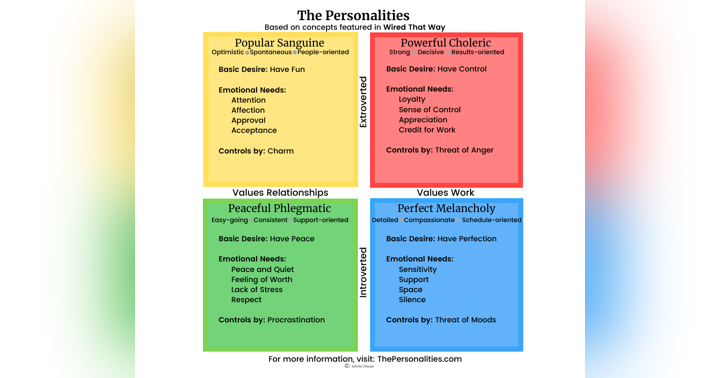
And audio. Okay, all right. So for our listeners who are only on audio, I've got in my hand an 8 1 2 by 11 sheet with a chart, but you can picture it in your mind. Picture just taking an 8 1 2 by 11 sheet of paper, and you've got two squares on the top and two squares on the bottom. And this is important. The layout makes a difference in explaining it quickly and easily. when you're picturing it in your head,
Shannon (15:26.923)
Yeah.
Marita Littauer (15:53.262)
Your top left square is the yellow, the popular sanguine. If you happen to be drawing it out, just put an S in that for the popular sanguine. Then the top right is what we call the powerful choleric represented by the color red. Then the bottom left is the perfect, no, excuse me, bottom right, because I'm doing it backwards. Bottom right is the perfect melancholy represented by the color blue. And then the bottom left,
Shannon (16:15.319)
You
Marita Littauer (16:22.822)
is the peaceful phlegmatic represented by the color green. And the reason that layout is important is to understand the opposites and so forth. So the perfect melancholy, the blue, is opposite of the popular sanguine. So while we popular sanguines are the loud, fun-loving, energetic, outgoing kind of person, the perfect melancholy is the introverted, the deep, thoughtful, introspective,
The blue represents deep blue like the ocean. And so this person is good with numbers, dates and times. They tend to be perfectionistic. And not only are they perfectionistic about themselves, they tend to expect everyone else in their orbit to be perfection, to be perfect as well. And that's where my mother and father got in trouble because they were this combination. And you remember I mentioned that we tend to marry someone who's opposite.
Then we go to the powerful choleric personality represented by the color red. And the powerful choleric personality is the strong, driven, goal-oriented kind of person. In the workplace, they're the ones who may step on other people to make it to the top. Now, by the time they make it to the top, they have a whole lot of enemies because they've alienated a lot of people along the way. But then people tend to think they're rude.
Shannon (17:21.068)
Yeah.
Marita Littauer (17:50.178)
However, this person thinks that's a virtue and they'll say, well, you always know where you stand with me. But they've offended people along the way and don't even realize that. They tend to point a lot and when they walk, there's kind of a thump, thump, thump, thump as they walk. So that's the powerful color represented by the color red. And then opposite of that is the peaceful, phlegmatic represented by the color green.
Shannon (17:57.102)
Yes.
Marita Littauer (18:20.182)
And as I like to tell people, really the best way to identify the peaceful phlegmatic personality is by process of elimination. Are they that loud, outgoing, popular, sanguine? No. Are they that strong, goal-oriented, powerful color? No. Are they that neat, organized, perfectionistic, perfect, melancholy? No. Well, then they're probably the peaceful phlegmatic because they're not as obvious to identify. And so truly one of the best ways
to identify this person is by process of elimination. But the peaceful phlegmatic is the one who's happy to be in the background. They're more the watcher kind of person. They're the one if you say to them, would you like coffee or tea? They will say, I don't care. It doesn't matter whichever is easiest because they're the ones who go along to get along. And unfortunately, this person is the one who can very easily be stepped on.
by the powerful choleric as they're climbing to the top. But yet everyone likes this person. In corporate America, sometimes the peaceful phlegmatic further in on career will get promoted ahead of the powerful choleric. And the powerful choleric is like, wait, how did that happen? I've done this and this and this and this. But the problem is you can picture a committee sitting in a boardroom trying to decide, should we put this person in that job?
Shannon (19:17.805)
Mm-hmm.
Ann (19:20.867)
Yes.
Marita Littauer (19:46.604)
or this person. And this person has a lot of enemies and everybody likes this person. And so this one can often get promoted ahead. Now, I'll find a little comment here. Part of the reason is the colors and the squares as I call them are important. You'll notice the top two the red and the yellow. They're hot colors. And this is the person who is the extrovert. This is the person who is out going.
And the bottom two are cool colors. This is intentional. These two are the ones that are the introverted, the low key kind of personality. The top two, we are energized by people. The bottom two are energized by solitude. That's part of the introvert, extrovert thing. And so that's a quick overview. And of course,
Most of us, I'm kind of about 50-50. These two, Shannon said, you said you're mostly this one with some of the peaceful phlegmatic. And I didn't hear from Ann yet on that. But that concludes here a kind of quick overview.
Shannon (20:48.951)
Yep.
Shannon (20:54.062)
Well, Ann didn't answer her personality test correctly. Let's let the whole audience know that. So if you take the personality test online, make sure you read the instructions that say you can answer more than one to the question, but don't because you won't get a true accurate reading if you answer more than one.
Marita Littauer (21:01.698)
Thank
Marita Littauer (21:20.558)
Yeah, you can if you're, if people are really stuck and they truly cannot decide am I this or am I this? And the other thing that's really important, the other thing that's really important on the profile, yeah, well, that's why you can check two because sometimes you just really can't decide and you can check two but it's advisable only in those rare instances.
Ann (21:27.62)
Thank you.
Ann (21:31.662)
cup of mine I was stuck on.
Shannon (21:45.675)
And also the instructions say you can ask a family member or friend their opinion of like if you're stuck and you think you're two, two of them fit you, you can bring in a third party that knows you well and say, I think it's more this one than that one, which is what I did. Cause I follow directions. Cause I'm a melancholy.
Ann (22:06.07)
my god. I'll re- I will re- I will retake the test. I will retake it. Just so you'll stop.
Marita Littauer (22:12.408)
Do call it an exit.
Marita Littauer (22:22.286)
Yeah, and I said the word definitions are really important also because they help you put the word in perspective of how it is intended in that usage. So it's a fun profile. It's a fun personality profile. We have it available in a paper copy. And I just shipped off 200 of these to one church in Bakersfield, California today. And I shipped off 25 today to a church in Tennessee. So we ship these off all over the place.
Ann (22:48.868)
awesome.
Marita Littauer (22:51.24)
And a lot of people take it online as well.
Ann (22:55.684)
So how do the personalities help people better understand themselves, not just how they act, but why they act the way that they do?
Marita Littauer (23:06.264)
Well, definitely it helps you understand why you act the way you do. But one of the things that I think is really important that's a little different from our approach to this topic than some of the other programs that are out there is that we emphasize that this is not just a label because there are many programs out there and I people tell me constantly, well, I took this profile or I took this course and I learned that I made this, whatever it is, but I don't know what to do with that.
And we like to look at more than just that label, but to use this as a tool for growth. And Shannon, you probably read this online that we talk about, this is a starting place. This helps you know where you are. But once you know what your strengths and your weaknesses are, and the personality profile here includes, and on the electronic version, you got emailed this same material.
Shannon (23:50.818)
Mm-hmm.
Marita Littauer (24:06.478)
has a whole chart of strengths and weaknesses of each personality type. So this helps you in a lot of ways. One of them is career, job selection. You're not gonna be happy in a job like my husband is a CPI, I mentioned that. And he's a combination of the piece, the perfect melancholy and the peaceful phlegmatic. And he is content.
in a windowless room all day long with a calculator and a computer. It's tax season right now. And, you know, that's what he's doing. Fortunately, at our age, he's semi-retired, but he does work full on in tax season. But he's content. I would sooner kill myself than sit in a room. I'm saying that facetiously. I don't want to be sound callous there, but, you know, I just would not, that was, kill me.
Shannon (24:37.166)
You
Marita Littauer (24:57.774)
to have to sit in a windowless room all day and do numbers. my gosh. So understanding your personality is really helpful in understanding what kind of job roles are gonna be fulfilling for you and are going to work for you. So that's one of the big advantages. As I talked about earlier, it's helpful in understanding those other people around you and having realistic expectations. But personally, you asked Ann, how does it help you
I think one of the most important things is using this as a tool for growth. And you all talked about that as kind of your program's goal is a tool for growth. It's not just a label, but if I realize where my weaknesses are, once I understand my personality, then my goal is, and we talk about this a lot in the book, it's not quite so much in the little actual profile itself, but there's a whole chapter on this in the book.
And that our goal is not just to stay there, but to grow and to mature. So for example, my natural personality is to be late because I have too many things that I think I'm going to do and I try to jam into a day. And because of that, I tend to be late. But as my ex-husband used to say to me, Marita, the airlines don't care if you're sanguine. They're going to leave on time.
Shannon (26:08.558)
you
Marita Littauer (26:25.528)
They're not going to stay an extra 10 minutes for the sanguine That's what he used to tell me. I mean, it's true. He was right. so I, as I traveled around the country as a speaker, I had to learn to show up on time. That's growth. That's maturity. I had to get organized to make sure I had everything with me when I get there and so forth. So that's a growth thing. Looking at my weaknesses and saying, I want to work
to overcome these weaknesses. I want to mature. And secondly, I want to work to acquire skills that are not natural to me. And Shannon, you'll remember from taking the personality profile online, one of the things it says is when you check the traits, if you had to read a book or go to a class to learn to be that, don't check it because that's not who you are naturally. But we're intelligent human beings and we can grow.
Shannon (27:19.235)
Right.
Marita Littauer (27:25.354)
And we can mature beyond what our natural tendencies are to acquire skills that are not natural to us. And so we have, that's one of the things that is so helpful in understanding your personality is that it gives you that tool, kind of gives you a baseline. This is who I naturally am, but I can grow above and beyond that. Now it doesn't mean that, you know,
I will ever be good at numbers just because I've learned to be on time. But that's a learned skill and that's the goal for all of us is to grow beyond our natural tendencies.
Shannon (28:05.944)
Yeah, exactly. And that's why I'm so excited after taking the personality test, now that I know what my personality is, I've got the book wired that way and I can't wait to dive into it. I've skimmed it a little bit earlier today after I read through what I got online from the profile. And yeah, it's really good. Like I was...
Ann (28:07.811)
Yeah.
Marita Littauer (28:16.495)
Yay.
Marita Littauer (28:26.338)
Took the profile.
Shannon (28:33.282)
texting Ann before the show because she sent me her results and I was telling her, let's see, where's it at in the book here? It's at the beginning where it has the part that has the personality itself and then like the weaknesses and right, yeah, the overview. And so I was reading to her what it said like about who those personalities tend to marry and
Marita Littauer (28:37.23)
you
Marita Littauer (28:47.95)
The description of the chart has no overview.
Shannon (29:00.738)
what they're afraid of and different things like that. And it was spot on for the both of us.
Ann (29:05.424)
so spot on. Yes. It's like, what is wrong with us? Me too.
Marita Littauer (29:07.463)
good.
Shannon (29:08.558)
So yeah, I'm ready to learn more so I can change certain things.
Marita Littauer (29:16.268)
Shannon, the book wired that way for any for Amazon, no for Kindle Unlimited members, the book is available free. However, I think this is the kind of book that's better to read in paper. So you can mark and highlight and so forth. But it is available electronically free for Kindle Unlimited members.
Shannon (29:39.736)
Okay, that's good to know. I didn't realize that. Yeah. I always, I never get the Kindle version of books. I have to have, I'm the kind of person, I'm old school. I have to have the book in my hand. There's something about turning the pages and...
Ann (29:40.708)
Good to know, yeah.
awesome.
Ann (29:51.448)
Me too.
Marita Littauer (29:56.462)
I'm very dedicated to my Kindle, not for this kind of book. I read a lot of novels in bed or in the bathtub, and I love my Kindle for that.
Ann (29:56.654)
The smell.
Ann (30:03.182)
Yes, me too. another bathtub reader.
Shannon (30:06.168)
Yeah. Well, I have my iPad for that. So I use my iPad for that. what's one misconception that people often have about personality typing?
Marita Littauer (30:08.334)
Yeah. Yeah.
Marita Littauer (30:24.686)
The biggest one is that they say, I don't want to be put in a box. And they somehow think that these, not just our program, but any of these programs, I mean, the Enneagram Disc and Myers-Briggs are the other kind of prominent programs that are out there. And people's complaint about this, well, that puts you in a box.
And as I discussed earlier with you, it really doesn't because the goal is, especially the way we teach it, is no, you're not stuck here. You want to grow and mature and acquire other skills. So almost I've had people a lot of times say, no, this didn't put me in a box. It actually let me out of the box that someone else had put me in. Help me understand who I really am. And instead of trying to be someone that someone else wanted us to be.
Shannon (31:08.078)
Mm-hmm.
Ann (31:08.717)
Yes.
Ann (31:13.188)
Thanks.
Shannon (31:18.05)
Yeah, and I think to help, it helps you too also in relating to other people. Like you talked about, you you being exposed to this as a young age, it was just something that came natural to you. You knew what your personality was. You knew the different personalities. So it was easier for you in interacting with other people, recognizing their personality and what you needed to shift or adjust, you know, and so.
Ann (31:18.53)
Right. I agree.
Ann (31:32.868)
Yeah.
Marita Littauer (31:45.154)
Yes. Yeah. And for example, if you're with someone who is that powerful choleric, as I mentioned earlier, the color red, you may think that person is being rude. And you could be offended by it. But once you understand that they're powerful choleric, I mean, it would be nice if they grew and matured too. But we are not responsible for them. We can't change those other people. But when you understand that that's their personality, then you understand
Shannon (31:57.592)
Right.
Marita Littauer (32:14.316)
that that person isn't being rude. That's just how they are. They say it as it is, they lay it out straight, and they don't they don't soften it up. And they view those of us who might want it softened up. They view us as weak. Because, well, you shouldn't get offended by that. I was just telling you what to go do. You know, people get offended where the peaceful flagmatic, which is again, my husband and close to 5050 there.
He doesn't really get excited about much of anything. And I have to just, you know, I accept that, that he's not gonna get all excited like I do about the dinner I made or, you know, anything like that. And otherwise, I would kind of want to slap him and say, hey, wake up, get with the program. And so it really helps to understand those other people and what their personality is.
Shannon (33:04.974)
Yeah.
Shannon (33:12.035)
Yeah.
Ann (33:12.236)
It really does. So as you.
Marita Littauer (33:14.38)
And it's the same for parenting. It's very effective. I I tend to teach it with more of an emphasis on marriage. I don't happen to be a parent. The chapter on parenting and why are that way I had my mother write basically, because I don't have that personal experience. But I certainly have nieces and nephews and friends that have children and it certainly helps to understand them and they're different. Any mother who's had more than one child knows.
that in the womb you can tell this one's different than the previous one. You have one that's kicking and, you know, really active in the womb and you've got another one who's maybe real passive and they come out and they're different.
Shannon (33:59.747)
Yep, exactly. Yep.
Marita Littauer (34:00.62)
They are wired that way.
Ann (34:00.818)
yeah, that's...
Ann (34:04.558)
That is very true, very true. So as you mentioned, there's so many different personality typing systems out there. What makes the personality so unique?
Marita Littauer (34:20.044)
the first thing that people tell me is how easy it is to grasp and apply. people, it's kind of user friendly. Meyers Briggs in particular, people that have been under that program, they may know they're a TMJ or whatever it is. But that's all they know and they'll be like, well, whatever it is, they don't have a handle on it.
where the colors are really helpful and relating and having people understand it. And one of the other things, as I mentioned, that really is different is the approach toward growth. The approach toward you're not just in a box. This label is just a starting place. And then I think the other really big thing that makes it different is the emphasis on relationships with others. So again, it's not just a label, it's about
relationships. And the fourth thing is the area of the emotional needs, because with each personality type comes a specific set of hardwired emotional needs. And when you especially in marriage or any, know, male females, partner relationship, a relationship like that, that you really can't walk away from easily because you have a lot invested in it.
You I promise people if you identify the personality of your partner, then you understand their strengths and weaknesses and begin to adjust their expectations accordingly. Then you can begin to meet their emotional needs. And that's where you can see real changes in relationships. You know, all of us were brought up on what was called or what is called the golden rule.
do unto others as you would have them do unto you. And I like to say that works really well if you're talking about children on a playground. You know, don't kick sand in my face and I won't kick sand in yours. But when you get to relationships, if I give my husband what I need, but he's a different personality. And so what he needs is not what I need. So in order to give him what he needs, in order to change my approach to him,
Marita Littauer (36:44.896)
I first have to care enough about that relationship to step outside of who I am and think about what does he need and give him what he needs. I like to say, you know, just by comparison, you know, the kid selling you a hamburger at the fast food restaurant, you don't care enough about that relationship to make that effort to step outside of who you are and so forth. But those people that you do really care about with it may be
partner, a friend, a co-worker, but someone that you are in relationship with who's different from you when you can identify their personality and then adjust your strengths and weaknesses as you understand, I mean, excuse me, adjust your expectations as you understand their strengths and weaknesses. And then lastly, and most importantly, but you can't start there because if you don't know who they are, you can't meet their emotional needs.
And once you understand that, and there's a whole chapter in the book that you'll see Shannon on the emotional needs of each personality type and in the literature in the print version of the personality profile and the electronic version that you received following taking the personality profile that is in there as well.
Shannon (38:01.742)
Okay, good. Yeah. Well, one of the things you do talk about in the book that I saw today is the visible clues. So can you talk about what that means and why that's helpful?
Marita Littauer (38:15.81)
Yes, it's especially helpful in your relationships with those other people. Because if let's say you're working with someone, you're in a job situation, and you've got someone that you're having a tough time with, it's difficult to go up to them and say, excuse me, I've got this personality profile here. Would you take this so I can figure you out? If you're in a tough relationship with that person, they may not be receptive to that. That may not go over really well.
And I find if you know what to look for in that personality, and I gave you a little bit of that in my kind of quick opening overview, but I find that if you know what to watch for, you can almost more accurately identify someone's personality type than they can themselves if they take a profile. Because for a lot of people, they have a lot of baggage tied up in who they think they are.
Shannon (39:13.666)
Yeah.
Marita Littauer (39:14.38)
what their parents wanted them to be, what their teachers wanted them to be, what their bosses wanted them to be, what their spouse wants them to be. And so by the time you get someone who's in our age group, since you said Shannon, you're not as young as I think you are, but when you get to be in our age group, a big group here, a lot of people have a lot of baggage tied up in who they think they are.
And I always use the example of if you're at work somewhere and you're standing around the water cooler or whatever, and one person says, there's a group of you there, and one person says to someone, you are so whatever. It could be scatterbrained, it could be organized, it could be whatever, any adjective like that. And someone says to that person, you are so, and that person says, I am not. And the people around them say what?
yes, you are. And then that person is like, really, am I like that? But you see, the people that work with you every single day, day in and day out, they know you at your best and they know you at your worst. And so often those people know you better than you know yourself. And so if you know what to watch for, those visible clues, like I talked about, we popular sanguines talk.
Shannon (40:14.168)
Yep, yep, you are.
Shannon (40:28.577)
Mm-hmm.
Ann (40:30.852)
Yeah.
Marita Littauer (40:41.518)
with our hands. I've had people in my younger years who would grab my hands behind my back and say, I bet if I held your hands behind your back, you couldn't talk, could you? And no, it would be very difficult for me because that's, I've got a friend of mine whose personality is very much like mine. And she regularly knocks over glasses of wine. It has nothing to do with how much she's had to drink. It has totally to do with, she talks with her hands and we're like, oh my gosh. And we go to
Ann (41:01.22)
Right.
Shannon (41:06.552)
Right?
Shannon (41:10.734)
You
Marita Littauer (41:11.52)
to grab it, you know, because that's how she is we're the perfect melancholy. They don't use their hands at all. They're much more stiff. And if they do use their hands, they're very close to the body. And as I mentioned, the powerful cholera, their frequent hand gestures to watch for is finger pointing, hands on hips, usually accompanied by a look that kind of says I cannot believe you did that. And then the other one is a fist pounding.
on a desk or a wall or into their other hand for emphasis, where the peaceful phlegmatic, they don't really use gestures, but they're more kind of reclining. They're leaning on a wall and they're kind of leaning back. so they've got more of that low key. Since you told me this is video, I don't like to show that because it shows my stomach, but the peaceful phlegmatic is more like that. So those are just, that's one portion of the visible clues.
Ann (41:55.618)
watching.
Marita Littauer (42:09.582)
Clothing is another one. Workspace, you can kind of see a little bit of my workspace here and I try to keep it clean for this, but I've had people in the past who would look at my desk and say, I don't know how you can get any work done. It gives me a headache just looking at your desk. But it works for me and I can try to clean it up and I do from time to time and it just ends up back like this. So, personal space, car, my ex-husband.
He had a brand new car at one point and we went to a drive through restaurant and he, we ordered and I started to eat in the car. no, you can't eat in the car. Like, what do you mean I can't eat in the car? Why would they have drive through restaurants if I can't eat in the car? And he said, once a car smells like French fries, it always smells like French fries. So perfect melancholies, their car is very important to them to keep their personal space.
very tidy. Does that relate to you Shannon?
Shannon (43:11.743)
yes, yes.
Ann (43:11.886)
yes, yes.
Marita Littauer (43:13.55)
Ha!
Shannon (43:16.942)
Now I do eat in my car though. I will eat in my car. But, but yes, I'm, my husband and my son, neither one liked to drive my vehicle because they're worried that, you know, they're going to move something or upset me.
Marita Littauer (43:20.003)
Well, most people, most people do. My ex-husband was a little bit anal about that.
Marita Littauer (43:34.518)
Yes, yes. That's classic. I love that Shannon. That's a classic example.
Ann (43:37.478)
Hehehehehe
Ann (43:42.5)
I love it.
Marita Littauer (43:43.784)
I don't like to take my husband's truck for the same reason. And I was driving it between Dallas and Lubbock, which is about a five hour drive one day. And I had an altercation with a buzzard, literally. This huge bird came up off the side of the road and headed toward my windshield. Fortunately, it didn't hit the windshield, but it hit the mirror on the side of the car and broke the mirror, or side of his truck and broke the mirror off. I can't tell you how many times I've heard.
Ann (44:07.304)
Shannon (44:09.387)
my gosh.
Marita Littauer (44:11.086)
that it cost $1,800 to fix that mirror.
Ann (44:14.008)
Yeah, I'm sure, I'm sure. You're never gonna not hear about that. know, throw that out there. Yeah. So I have to ask Marita, how does focusing on strengths rather than flaws change the way people use these personality insights?
Shannon (44:16.046)
Ha ha ha ha ha!
Marita Littauer (44:19.478)
That is very true. That is very true. Yeah.
Shannon (44:22.563)
Yep.
Marita Littauer (44:34.926)
by focusing on not just your strengths, but looking at the strengths of other personalities that you want to make a conscious decision to acquire. And that's the core to that growth module that we were talking about is when you realize, you know, my personal strengths are these strengths. And that's helpful because as we talked about job roles,
You know, want to ideally, you're gonna be most happy long-term in life in a job role where your strengths fit the position. Who's gonna be at the front desk and not, if you put a melancholy cholera at the front desk reception area, that's a bad thing. And so the strengths are really helpful focusing on the strengths in that way. But then focusing on those strengths of the other personalities,
You see it listed out there as we've talked about. And it's very easy to look at that list and go, okay, I don't have that. I want to work to achieve that. And we can, and it'll never be natural, but we can grow and mature. focusing on the strengths is helpful in those two ways.
Ann (45:52.259)
gotcha
Shannon (45:52.847)
And in doing that, is that how we help to improve our relationships with others like in marriage, family, friendships or?
Marita Littauer (46:04.418)
Well, it's certainly a piece of that puzzle because if we can, you know, I mentioned the buzzer incident. My husband, God bless him, he, I'm not, I wasn't in trouble over it. I didn't have to pay for it though I did offer. But I didn't have to pay for it and I wasn't in trouble. But, you know, so he's not.
hounding me about that, but he understands who I am. I understand who he is. And so it's helpful in relationships. It's a real core thing for relationships to understand those other people that we're in relationship with. And I'm not sure I answered your question, Shannon, because I got off on a tangent. Did I answer your question?
Shannon (46:49.454)
Yeah, no, that answered the question.
Ann (46:51.684)
You did.
Marita Littauer (46:54.71)
I do tend to get off on tangents.
Shannon (46:56.494)
That's part of your personality.
Ann (46:58.66)
So what happened? Right? Exactly. You can't help it. So yeah, some of us just are. So what happens when we stop expecting people to think and respond like we do?
Marita Littauer (47:00.628)
Yeah. Yeah. I'm hardwired that way.
Shannon (47:07.054)
Yeah.
Marita Littauer (47:09.889)
Yeah.
Marita Littauer (47:15.924)
well, you're much easier on those other people. And your relationship can be much warmer when you stop expecting them to behave the way you do or the way you want them to. You can have a much more open and honest relationship with them. ideally, ideally, if you take this personality profile, anyone, I know you both have already done it, but anyone, and Ann's gonna redo it, but.
If anyone takes the personality profile and puts these concepts into practice, you start to grow yourself. You start to have fewer obvious weaknesses and you acquire strengths from some of the other personality types. And then you begin to adjust your expectations of other people. Hopefully, assuming you're dealing with relatively normal people, because there are people who, you know,
There are people out there who just plain do not want to be gotten along with. And we've all had issues with people like that. And you can be as nice to them as possible. You can approach them in a way that would work for their personal and they're not having any of it. But ideally, dealing with a basically normal person, as you grow and mature, the people around you are going to say, you know, I've noticed that you've you've toned down or you've gotten less fussy about your desk or you
Shannon (48:30.819)
Mm-hmm.
Marita Littauer (48:45.602)
you know, whatever those things might be. And hopefully then they will be receptive to say, well, you can tell them what you did. They say, well, I'd like to take that personality profile. Like Shannon, you said you've got gals at work who are now going to take it. So, you know, if someone is open to the concepts, then that's like huge because if there's two people in a relationship and you both can actually talk about it,
Shannon (49:00.131)
Yeah.
Marita Littauer (49:14.432)
And you can use this. I've had many people will say, you know, I took that personality profile and I took it home and my husband and I went through the strengths and weaknesses chart. They are like, when we went over that together, and again, that requires someone being open to doing this. Then they say, well, it wasn't like me being critical. It was like the paper talking. And so often people are much more receptive to looking at those weaknesses.
when they're on that piece of paper, then if you were to say, well, you need to do this and you need to do this and you need to do this, you approach someone like that and they're gonna put a wall up and you're not gonna get anywhere. Where it's beautiful if that other person is receptive to the concepts. And I have found that even generally when someone is not receptive to it, if the person they're dealing with, again, friendship, work, partner, whatever,
Shannon (49:49.762)
Yeah.
Marita Littauer (50:12.032)
If that person has taken this to heart and they're becoming better and they're growing, a normal person will notice that and be interested in what did you do? What's happened?
Shannon (50:24.354)
Yeah, that's true. Can you give us an?
Ann (50:24.676)
Nice.
Marita Littauer (50:27.084)
Again, it takes that normal person because there are people out there who are just, know, mean honestly some of them have some psychological issues. and there are those people out there that just do not want to be gotten along with no matter what.
Shannon (50:33.72)
Yup.
Shannon (50:42.508)
Yep, exactly.
Ann (50:42.818)
Yeah, that's true.
Marita Littauer (50:44.972)
So you have to realize that there are those people.
Shannon (50:48.022)
Yeah. Can you give us an example of how understanding this has helped someone experience more compassion or less conflict?
Marita Littauer (50:59.508)
yeah, very easily. If you've got someone, I'm just trying to think. I've got a friend right now who is sanguine like I am, but she has had knee replacement surgery and it is not going well. And understanding that she's a sanguine personality, those of us who are the popular sanguines, we want you when we're having a tough time.
We want you to touch us, hug us, tell us it's going to be okay. We want you to bake cookies for us or whatever. And understanding that that's how this friend is, I check in with her regularly, send her a text, how are you doing, where it would be very easy for that very same person who's usually married to someone opposite who's maybe the choleric melancholy combination.
who after a couple weeks, and this friend of mine, I've had several friends have knee replacement surgeries because I'm in that age group. And most of my friends after about two weeks, they're not better, but they're up and they're walking and the pain has subsided and they're doing much better. This particular friend had a knee injury from cheerleading when she was 16 and she has had a tough road.
And I talked to her today and I feel like she's finally doing better. But if she was married, if she's married to, which she is not, but if she was married to someone who is that powerful choleric personality, it would be very easy for that person to say, you need to buck it up. You you've been lying on that sofa now for three weeks and you need to get over it. And that's what the powerful choleric view of illness is.
Shannon (52:22.253)
Yeah.
Marita Littauer (52:50.344)
is they view illness as a weakness and they're not sympathetic to someone who's sick. And so, you know, for this friend of mine with this knee surgery, the group of girlfriends that I'm in, we've sent her flowers, we've brought her food, we've dropped by to visit her, you know, and we continue to love on her and understanding her personality, that's what she wants. Now,
Shannon (52:53.102)
Mm-hmm.
Shannon (52:57.378)
Yeah.
Marita Littauer (53:16.332)
We have another friend in our group who also recently had a knee knee replacement surgery. Her personality is very different. We didn't even know she'd had the knee replacement surgery until after she'd had it. One of us found out about it. And that that person lined up, got us bringing food and so forth. But this person's very different. She didn't want a lot of attention. She's a melancholy.
Shannon (53:32.706)
Wow.
Ann (53:33.157)
wow.
Marita Littauer (53:43.96)
She's a horticulture professor for God's sake. And she didn't want a lot of attention. She didn't want people fussing over her. So same knee replacement. Now, admittedly, the melancholy one has not had as rough a time. She's had a more traditional time on the knee replacement. But the sanguine one, she has been so appreciative of all of us loving on her, hugging her, patting her.
And you know, really it applies. These concepts apply in every area of life you could possibly think of from, you know, your health to your desk to your, your relationships with others. It applies really, it's, it applies everywhere.
Ann (54:29.444)
It really does. So how can the personalities help someone live more authentically instead of always trying to just fix themselves?
Shannon (54:30.104)
Yeah.
Marita Littauer (54:41.634)
You
give a say you don't need to fix yourself because I believe we want to grow and mature but when you embrace when you understand who you are as I shared with you with my mother and father's relationship early on my mother felt like who she was was not okay because my father's personality type and hers were so different and he was more of the controlling type of personality and he made her feel like she was not okay
And when you understand this is who I am, this is what I'm hardwired to be, it gives you a different level of freedom and peace at who you are. And to realize that I am never gonna be that neat perfectionistic kind of person, though I can grow and mature and be more organized, I'm never going to be that. It does give you a peace and acceptance of who you are.
especially if you've had parents or a boss or a spouse who is constantly nitpicking you and trying to fix you. When we try to grow ourselves, that's one thing, but when someone outside is trying to force us into something that we are not, that's a whole different thing. Yeah, exactly.
Shannon (55:53.027)
Yeah.
Ann (56:00.494)
It's not okay. Yeah. Yeah.
Shannon (56:02.722)
Yeah, yeah. So how has your understanding of your personality evolved over the years?
Marita Littauer (56:11.642)
How has it evolved? since I grew up with it so early on, that's a tougher thing to answer. But as I said, I've had to learn to be organized to get to the plane on time. I've had to learn, you know, my husband thinks that every day I'll come back into the house, I'll leave the house and I'll go, oops, I forgot something. And he's like, what a surprise. Because I'm back in and you know, so.
Ann (56:14.916)
You
Marita Littauer (56:39.71)
I seldom, I don't know, seldom get somewhere without what I need, but I sometimes have to make a couple trips. Sometimes I'm halfway down the street and I have to turn around and come back to get it. you know, it's, again, it's that acceptance of who you are. And my husband's like, no, what a surprise you're back.
Ann (57:00.42)
I like that.
Shannon (57:01.229)
Yep.
Marita Littauer (57:06.744)
Yep.
Shannon (57:07.566)
So carrying forward this legacy like your mother's is meaningful and very complex. What has that journey been like for you personally?
Marita Littauer (57:21.016)
You know, it's been very natural for me. And I'm kind of as I just recently realized, like back in October, realized that my book was facing its 20th anniversary of publication. And as a result of that, I kind of renewed my focus. And that's part of why I'm doing these podcasts. And I really do want to keep the legacy alive. So.
My mother passed away six years ago in 2020, in July of 2020. And at the time, I remember sitting by her hospital bed, and I was developing at that very time, the online personality profile that you both took advantage of today. And so I developed that six years ago. And for me, that was a part of keeping that legacy alive. In the past year, 2025,
I developed an online personality training course to certify people to teach this material. My mother and I back 20 years ago, we did in person three day long classes to train and certify people to teach this material. And on our website, I have many of them listed, by no means all of them, but many of them who do coaching, who do life coaching.
and they use the personalities in that. And I have many of them listed on the website with their contact information. So someone who wants more or has a more complex relationship, I don't personally do that. But many of the people that we've trained do. And I've had people over the years asking, are you gonna do, are you ever gonna bring that, bring back what we used to call the certified personality training workshop?
And I would kind of go, no, don't think, you know, the world's a different place and people don't have three days to go to a seminar and so forth. But last year I developed this 18 lesson online certified personality trainer course that people can take and become certified to teach this material and use it in their coaching practice or in their speaking or their business consulting. Those are some of the ways that people use it.
Marita Littauer (59:41.56)
So those are some of the things that I've done more in recent history, but to keep that legacy alive. And then the podcast that I've been doing, if you were to go to my website, thepersonalities.com and you go to the free resources tab, I have a link to the podcast that I've done that people can go to and listen to. And as soon as I have that from you, I will add this.
Ann (59:50.308)
It's amazing.
Marita Littauer (01:00:09.912)
to that as well. So people have that extra training. So I am very actively working to keep that legacy alive.
Shannon (01:00:18.423)
wonderful.
Ann (01:00:18.766)
That's amazing. So what lessons from your mother still guide you today?
Marita Littauer (01:00:26.134)
Well, really, I mean, all of this, but, my mother taught me to be a speaker and a writer as well. So I was doing a podcast a couple nights ago with someone and the theme of that particular podcast was book writing. And I said something to him that I hadn't said because I'm not really doing any of that work these days. But I said something to him that I, as I said it, I can hear my mother saying it. My mother's voice is like,
Ann (01:00:54.052)
You
Marita Littauer (01:00:55.086)
It's like I'm channeling my mother came right out of me and that was, do you have anything to say and does anyone need to hear it? And that's as we used to teach, she and I together used to teach people to be speakers and writers. And that was kind of one of the core things is do you have anything to say and does anyone need to hear it? And that's a lesson from her that as I said, it was, just.
It was like I heard her voice saying it. It was kind of funny.
Ann (01:01:26.34)
love that.
Shannon (01:01:27.798)
Yeah, it's funny how that happens sometimes, especially after your parent passes and you're doing something or whatever and it's just like your parent literally like comes out of it. Exactly. I've had that happen so many times. Yeah.
Ann (01:01:31.137)
Mm-hmm.
Marita Littauer (01:01:31.224)
Yes.
Yeah.
Ann (01:01:34.531)
Yes.
Marita Littauer (01:01:39.072)
So I go, my gosh, I had become my mother.
Ann (01:01:44.514)
I always feel like she's there with me. Yeah. I feel like she's there, you know. She knows that that just happened. Like, mom.
Marita Littauer (01:01:47.04)
Yes. Uh-huh. Yep. Yep. I agree.
Shannon (01:01:52.425)
Exactly. Yeah. So I think you've done such a wonderful job honoring the foundation that she built, but also bringing in your own voice to the work. I think it's wonderful.
Marita Littauer (01:02:04.844)
Well, thank you. Yeah, I appreciate that. think I'm happy with it. I think mom would be happy as well. I mean, I know she would be like said, she was in the hospital bed and I would read her. Okay, so this is what we're going to say here. And you know, she was she was still with it enough that she could respond and pay attention to what I was saying. So
Shannon (01:02:17.934)
Yeah
Ann (01:02:25.412)
I know she's so proud of you. So for someone curious about the personalities but not quite sure where to start what's the best first step?
Marita Littauer (01:02:28.974)
Thank you, Ann.
Marita Littauer (01:02:40.75)
Well, as each of you have done today, I would suggest they go to thepersonalities.com and take that personality profile. just $4. It's easy to do. It's instantaneous. It gives you instant scoring. And then on that free resources section of the website, there's a lot of different, there's...
a speech of me, there's basically about a 40 minute long speech of me. It was actually done as a church service. And I think it's one of the best quick overview presentations. I had an opportunity one time, I was asked to go speak somewhere and I was asked to speak. It was a big women's conference, one of those Friday night, all day Saturday kind of conferences.
and they had a comedian scheduled to speak Friday night. And the comedian canceled days before the event. And the event planner was a friend of mine and she said, can you fill in for this comedian? I said, you know, I'm not a comedian. I have funny stories and people laugh when I speak, but it has to be hung on the framework of the personalities.
Shannon (01:03:39.342)
Wow.
Ann (01:03:41.284)
You
Marita Littauer (01:03:56.106)
And if you will, you know, if I can do it that way, I'm not a comedian, but I will do the, will focus on the funny stories. And so I only did that one time in my entire life that the focus was to be funny. And there is that recording is available in the free resources section of the the personalities.com. And then my mother,
I used to run a major women's conference, one of those kind of women's conferences. was Friday night, all day Saturday, Saturday night and Sunday morning. And we had hundreds of women in attendance. And so one year I had my mother scheduled to teach on the personalities on Saturday. But I said to her, Friday night, what I want you to do is the best funniest stories of each personality type. Because what I want you to do is I want the women to be excited to come the next morning.
to learn more. And so she did that and she'd never done that before and it's very funny. And that is available on the free resources section of the website. So other than taking the personality profile, there's a lot of really good kind of overview material that is in that free resources section. And I'm actually gonna be adding some as soon as honestly I can figure out the technology.
Ann (01:04:58.884)
you
Marita Littauer (01:05:19.552)
we have of my mother a really classic used to be four cassette now it's four CD but nobody has a CD player anymore and I hardly sell any of them if I sell any of it I maybe sell four of these sets a year so I as soon as I figure out the technology I'm just gonna make that whole thing available in the free resources section as well because as you mentioned carrying on that legacy
You know, I'm not selling it, so I may as well give it away and let people have that knowledge available to them. So the free resources section of thepersonalities.com really has a lot of good material there that people can take advantage of.
Ann (01:05:50.627)
Right.
Ann (01:06:02.219)
Awesome.
Shannon (01:06:02.434)
Good to know. If someone listening feels misunderstood or feels like they've spent a lifetime trying to be someone that they're not, what would you want them to hear today?
Marita Littauer (01:06:14.776)
that God made you the way you are, that we are hardwired with that built-in personality type, while we can grow and mature. It's helpful to understand that while someone in your life may have constantly been trying to change you, if you can focus on your strengths, you're great the way you are.
Shannon (01:06:37.486)
That's a great message. Yeah.
Ann (01:06:39.46)
It's a wonderful message. Summary to... Yes, exactly. Summary to...
Marita Littauer (01:06:42.488)
But it's important to focus on those traits.
Shannon (01:06:45.357)
Yeah.
Marita Littauer (01:06:48.202)
and not use it as an excuse. You don't want to use it as an excuse for being late or sloppy or bossy or whatever.
Ann (01:06:51.684)
come on! I already had plans!
Marita Littauer (01:07:00.717)
Yeah.
Shannon (01:07:04.046)
you
Ann (01:07:04.408)
Now that she knows it's just my personality, I can't help it.
Marita Littauer (01:07:07.756)
Yeah, yeah, that's not the thing to say. That's not the goal. Not what we've been talking about, Ann.
Shannon (01:07:12.366)
Hahaha!
Ann (01:07:19.78)
So, Marita, where can our listeners find out more about you and your work?
Marita Littauer (01:07:26.168)
Well, thepersonalities.com. Also, as I mentioned earlier, if you're a Kindle Unlimited member, the Personality Plus book is available to you free. So that's a good resource. And my other books are on Amazon as well. So many of them are out of print at this point, but not wired that way.
Shannon (01:07:47.375)
Good. So, Marita, thank you for reminding us that self-awareness isn't about labeling. It's about understanding, compassion, and living with intention. And to our listeners, learning who you are isn't about changing yourself. It's about embracing the way you were designed and using that understanding to build healthier relationships and a fuller life for yourself.
and we'll make sure to link Marita's information in the show notes and it will also be on our website, traveltimestories.com. And take a moment to share this story with someone you think needs to hear it, leave a review. It truly helps these stories reach the people who need them the most. And until next time, keep traveling your story and keep making memories for life.
Author/Public Speaker
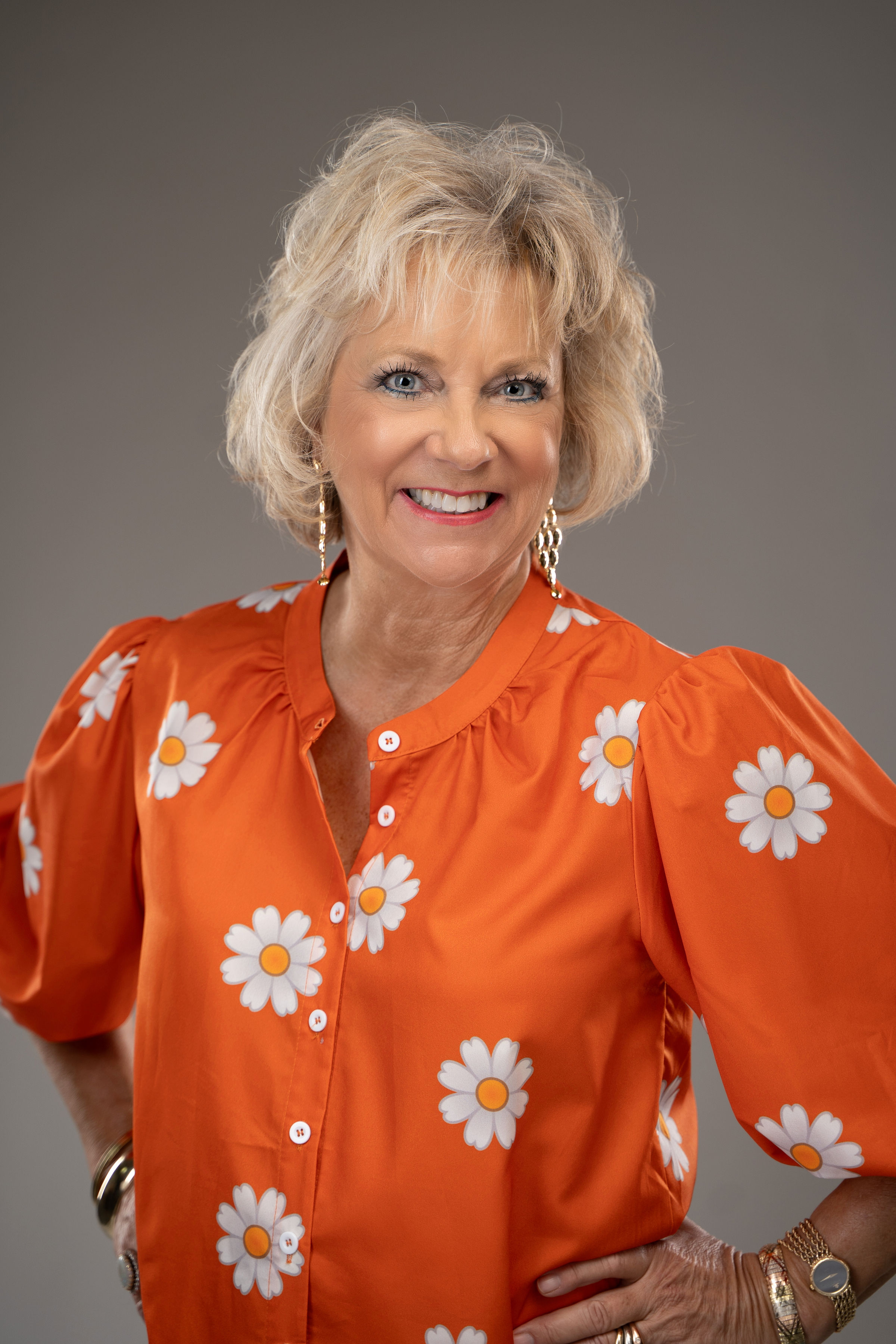
Marita Littauer Tedder is a multifaceted author, speaker, and entrepreneur based in Lubbock, Texas. With more than 50 years of experience, she has dedicated her career to empowering individuals to understand themselves more deeply and live fulfilling lives.
As the daughter of renowned speaker and author Florence Littauer, Marita was immersed in The Personalities from the age of nine, traveling with her mother, and eventually carrying forward the family legacy. She brings unique insight into identifying personalities through visible clues and applying an understanding of The Personalities to strengthen relationships. Through her writing, speaking, and other professional ventures, Marita exemplifies a life of purpose, resilience, and continual growth—remaining committed to inspiring others to live with authenticity and intention.