

 Apple Podcasts
 Spotify
 Youtube Music
 We Left Everything Behind With No Plan and Found What Actually Matters (feat. Chip Scholz)

What happens when you leave everything behind… without a plan?
In this deeply reflective episode of Travel Time Stories, Shannon and Ann sit down with Chip Scholz to explore a journey that wasn’t just about moving across the country—it was about letting go of control, navigating uncertainty, and discovering what truly matters.
With two adults, two kids, two dogs, and five cats packed into a 19-foot travel trailer, Chip and his family set out from Los Angeles to North Carolina with no jobs waiting and no clear roadmap forward.
What followed wasn’t just a relocation—it was a month filled with unexpected challenges, small crises, moments of doubt, and quiet grace. But somewhere along the way, everything shifted. In this episode, Chip shares how that experience reshaped his perspective on: Transition and starting over The illusion of control The difference between moving fast and moving honestly Finding meaning in life’s quieter moments And how uncertainty can reveal what truly matters
As the author of Every Dog Has Its Day, Chip brings a thoughtful, grounded perspective on how life’s biggest lessons often come from the moments we don’t plan for.
This conversation is for anyone navigating change, feeling uncertain, or learning to trust the process—even when the path ahead isn’t clear.
✨ Sometimes the road doesn’t give you answers… it gives you perspective.
👍 If this episode resonates, don’t forget to like, subscribe, and share it with someone who might need it.
Chip Scholz: scholzandassociates.com https://www.linkedin.com/in/chipscholz/ https://www.facebook.com/Chippturns https://www.instagram.com/chipscholz/
🎧 Listen, reflect, and remember— Join the community at www.traveltimestories.com learn more about us and our past guests, read our blogs and sign up to be a part of The Story Circle by becoming a member.
You’re allowed to move forward… even when you don’t have it all figured out.
#podmatch #traveltimestorieswithshannon #tunein #storytelling #newpodcastepisode #healingjourney #authors #adventureawaits
SPEAKER_01
What happens when you pack your entire life into a nineteen foot trailer, two kids, two dogs, and five cats, and no real plan?
SPEAKER_02
No job lading, no clear destination, just the road and a whole lot of uncertainty.
SPEAKER_01
Today's story isn't just about a cross country move. It's about what happens when life strips away your control.
SPEAKER_02
And you're forced to figure out what actually matters.
SPEAKER_01
Because sometimes the most important journeys don't look like progress at all. Every journey has a story. And every story has the power to heal. My story hasn't been ordinary. I was adopted, I'm a survivor of abuse and trauma, and I have more than a dozen siblings. That's just the beginning of my story. Life has taken me on a long and winding road of healing and personal growth. A journey that ultimately led me back to myself and the path I was meant to walk. Along the way, I discovered that stories have power. The power to connect us, to help us grow, and even to help us heal. This is Travel Time Stories with Shannon. Real journeys, real stories, and real healing. What happens when you pack your entire life into a 19-foot trailer, two kids, two dogs, and five cats, and no real plan?
SPEAKER_02
No job lading, no clear destination, just the road and a whole lot of uncertainty.
SPEAKER_01
Today's story isn't just about a cross-country move. It's about what happens when life strips away your control.
SPEAKER_02
And you're forced to figure out what actually matters.
SPEAKER_01
Because sometimes the most important journeys don't look like progress at all. Welcome back to Travel Time Stories with Shannon, where we explore the journeys that shape us, not just where we go, but how those experiences change who we become.
SPEAKER_02
And sometimes the most meaningful journeys aren't the ones that are perfectly planned. They're the ones that unfold one uncertain step at a time.
SPEAKER_01
Today's conversation is one of those stories.
SPEAKER_02
Today's guest is Chip Schultz. He is a storyteller, a craftsman, and author who describes himself simply as a man with a lathe, a pocket knife, and a few stories.
SPEAKER_01
After a long career in business and coaching, Chip discovered that the most important lessons don't usually arrive in big dramatic moments. They show up quietly in everyday life.
SPEAKER_02
And those reflections became the foundation of his book. A collection of thoughtful stories about life, craft, and the small decisions that shape who we become.
SPEAKER_01
Chip, we're so glad you're here. Welcome to the show.
SPEAKER_00
Oh, Shannon and Nan, thank you. It's a delight to be here.
SPEAKER_01
So one of the stories that really stuck with us is your family's move from Los Angeles to North Carolina in a 19-foot travel trailer. There were two adults, two kids, two dogs, and five cats. That alone is a story in itself. But can you take us back to the beginning of that journey? What led to the to that decision? Yes. And when you say there was not a plan, what did you actually what does that actually look like?
SPEAKER_00
Well, so, you know, long story short, I I've moved around a lot in my life. I grew up in Chicago and lived in the South and got tired of living in the South and got moved west and and we were living in Los Angeles at the time. And I got laid off in in May of 98 from um from my job as a uh lobbyist in in uh California. And uh I called my wife and I said, Well, I got the package, and she said, Well, great. So what do you want to do? And I said, I don't know, but I don't want to do it here. And uh, and so we um we planned, we uh started building a house back in North Carolina. We decided to move to um the Charlotte area just outside of Charlotte. And we took about a year to build the house, and when it came came time to go, we tried to figure out how we were gonna get five cats and two dogs across country, and there was no good answer. You know, it was gonna cost us like a couple grand to ship the cats, and you know, were they gonna be there when we were gonna be there, and maybe the dogs were gonna go with us. And it wasn't two kids, it well, it was it was two kids to start. One of them went back home to LA when we got to Albuquerque, but uh um three humans, two two dogs and and three and five cats. And so yeah, they're in and a 19-foot travel trailer. So, you know, I'd never done a travel trailer before. And if you've ever if you've never done a travel trailer before, first mistake was I had a Toyota RAV 4 at the time. And we we went out and picked up the travel trailer in Almaty, California, and we had about a 45-minute drive home. And that trailer liked to kill us on the way because the RAV4 was just wasn't a heavy enough vehicle and it wasn't set up for it. And so, you know, we realized that all of a sudden we had to get a new car, and and so we uh you know went down to the used car lot and found an um an explorer that would um would take us and you know had it all changed the hitch out and everything else, and so we got that taken care of. Then on the day we were leaving, we took our our dogs in to get groomed, and uh we had a a cocker spaniel and a boxer at the time. And the boxer, I think the boxer was about 10 years old at the time, and we took them in to get groomed, and during the day the boxer collapsed a couple of times. Oh my gosh. So before we left, we had to go find an emergency vet. And the emergency vet, well, he said the dog has uh cardiomyopathy, and so um, you know, just keep it keep her um keep him quiet, you know. Uh um, and and he gave us some tranquilizers. Well, we found out since then that tranquilizers are the absolute worst thing you can give with a dog with cardiomyopathy. And I'll tell you how we know. And we had we had just decided to loaf our way across um country, and and so you know, the first night we spent the night in Barstow, California, um, which is a uh interesting place to be. The next night um we went in Flagstaff, uh, Arizona, and uh um I think uh um we we would we got to Vegas and so we're in Vegas and it's July. So it's about 120 degrees out, and we kept the air conditioning going. Yes, we kept the air conditioning going while we we were um going, and and we had taken about a five-hour ride in in the meantime. So so here's another one of those things that you learn. We we had thought we were gonna keep the cats in the car with us in in cat carriers. And so we put the cat carriers in the back of the car, and we put five cats, and we drove with them, and they caterwalled the whole time. And we even had them even had them drugged, and they caterwalled the whole time, and they're just screaming. So so that that part of the plan didn't work. And uh, and so we decided we were gonna we were gonna get the the trailer as cold as possible and then drive for about three hours and put the cats in the back. Well, we get to Vegas and one of the cats is under a sleeping bag in one of the beds and is damn near dead from the heat. We had to learn all about that. And oh, by the way, you know, when you get cats in a in a trailer, what they all did, and it was really amazing, is to see they would all cluster around the axle where it wasn't bouncing so much. So they found the place that was the most stable. I thought that was really cool. Anyway, so yeah, so so we did that, and we went to Vegas. We spent a couple days in Vegas and had a good time, kept the air conditioning going, took care of the dogs and the cats and and everybody. And so we're on our way out and we're going across the Hoover Dam, and I look back, and all of a sudden the boxer is not doing well. I mean, it it's lying there, and its tongue is hanging out to one side, and its lips have have gone white. And I thought, oh my God, what what yeah, what's what's happened? Well, we had given it a tranquilizer, and again, the tranquilizer doesn't really do well with cardiomyopathy. And we we thought we had lost her, and so we we got to a place that um you know we were able to get some water and get her, you know, we called the emergency vet and she pulled through, thank goodness, but my goodness, you know. And she she passed away about six months after we got to North Carolina, but she didn't pass out on or pass away on the road, thank God.
SPEAKER_02
Yes, definitely. That would have been worse. Yeah, really horrible.
SPEAKER_00
Yeah, so so you know, we just had all kinds of adventures. The uh um driving a travel trailer is a unique experience. Leveling a travel trailer when you get to a campsite is a unique experience because it didn't have automatic levelers, you know. We had to we had to put things under the wheels and and level it out. And you know, cooking is uh is an interesting proposition. I I don't know if you ever remember the the uh movie um which is uh a vacation um with Chevy Chase.
SPEAKER_01
Yeah, yeah, yeah. One of the National Lampoons Vacation.
SPEAKER_00
Um we were the Greswolds, and uh and that's the way we felt is we we kept watching that movie because we were the Greswolds.
SPEAKER_02
Chip, you've you've described that trip as such a stretch of uncertainty, loss of control, and all of these small crises. What were some of those moments where things didn't go as expected? And how did your family handle that uncertainty together?
SPEAKER_00
It was a great tenderizer because you know, we want to make s everything certain, don't we? We want to make everything certain. We want to we want to know what to believe in and and how to believe. And and when you're on the road like that, I mean I I I I think being on the road is is fantastic. I I really love it. Um and and when you're on the road like that, you know, we had certain destinations in in mind, but you know, if we wanted to see the world's largest ball of twine, um, you know, we we found a way to to see that. And uh um and it just, you know, it kept loosening us up. The other thing, uh um, while we were driving, and we didn't drive more than three or four hours any day, which was, you know, which was really good. But what we did is we listened to audiobooks, and and this was this is back when audiobooks were books on tape. And I still remember there was a Sydney Sheldon book that we listened to, and I I got I hope never to listen to another Sydney Sheldon book in my entire life. And and you know, Sydney Sheldon is trying to be steamy and you know, isn't isn't he's kind of like softcore. Sydney Sheldon that he writes this thing and he said, said, and she and he took her and she liked it. And the way it was defined on the audiobook is like, oh my god, you know, I'm here with my daughter and uh my wife. And he took her and she liked it. And that became kind of a catchphrase for us over the years.
SPEAKER_02
It's so embarrassing when your kids are with you and something like that happens.
SPEAKER_00
Well, yeah, I mean, you know, she was a grown-ass kid when she was with us, so it wasn't it wasn't like she was a toddler or anything, but yeah, yeah, it's still it's still, you know, it's one of those moments. I I yeah there's there's all kinds of catchphrases that that come from things like that, right?
SPEAKER_01
Yeah, exactly.
SPEAKER_00
Yep.
SPEAKER_01
You talk about liking road travel or road trips. I do as well. I mean, I grew up, you know, back in the day when that's what you did for vacation is you know, you took your family took a road trip. And yeah, we have so many catchphrases that came from our road trips. One of my favorite ones is my dad had went the wrong direction on a trip. And so it became, well, you never would have seen that if we hadn't come this way. So then every time somebody took a wrong turn, that was the phrase that was used every time.
SPEAKER_00
Yeah, yeah, yeah. I mean, going back uh when I was a kid, you know, my uh my mom and dad would would put boards over the back seat and put down cushions. And so, you know, it was just one big seat, and that was us in the back. I mean, good God, we could have gotten killed if uh if we weren't, you know, um seat belts weren't a thing back then, but uh you know just uh um some great times on the road. And those are those are great times. I I think everybody needs to travel. Just to have to put up with your family for for a week or two weeks is you know, it's it's good training.
SPEAKER_01
Exactly. It makes some really great memories that you never forget.
SPEAKER_00
Oh yeah, yeah. Yeah. So, you know, that was that was a month and a half on the road, and and uh we saw some incredible things. Um we we came through Oklahoma City just um shortly after the Timothy McVeigh bombing and uh wow and and saw um the the Mira Federal building. In fact, I was just in Oklahoma City a couple weeks ago and uh went and visited the memorial, and it's so so neat to see that years later when they did complete the memorial, but this was this is before the memorial was completed. We saw the uh Grand Canyon of Texas, just outside of Amarillo, and and uh um and it's funny, it's going back to uh the Grand Canyon, we actually went to the Grand Canyon, and it it's funny, in 13 years of living in LA, we never went to the Grand Canyon. And so we went to the Grand Canyon, we drove up onto the north rim, we looked out over, and we almost did the the vacation thing. We kind of looked around and went, okay, we've seen it, and got back in the car and headed back to our campsite and Flagstaff.
SPEAKER_01
Yeah. Well, we did the European version of national lampoons a couple of years ago. We went to Scotland and Anne was driving, and you know, they have many, many roundabouts and that are many lanes long. And if you're not in the right lane to start with, like you have to circle around many times to get into the lane you need. And so as we're circling around, I looked at her and go, There's Big Ben. There's Big Ben again.
SPEAKER_00
Oh, that's great. That is great.
SPEAKER_02
Yeah. So that's our roundabout catchphrase right there.
SPEAKER_00
Oh my goodness. Oh my goodness.
SPEAKER_01
Yeah, so I felt like the Griswolds in that moment as we're circling the roundabout several times to get into the right lane to exit. Yeah.
SPEAKER_02
There were a few of those that that happened, so I'm just gonna throw that in.
SPEAKER_01
Exactly. So what do you think that that trip taught you, Chip?
SPEAKER_00
Well, it probably didn't teach me enough because there were lessons that uh that I learned since then. It ain't a thing. That's really what it taught me. It ain't a thing. And and as as uptight as I was, because there were a lot of times when I was uptight, you know, not not knowing we we knew what our destination was, but not knowing what we was here when we got here, we didn't have jobs, we didn't you know, we didn't know what we were gonna do and and or how we were gonna do it. And and so there was a a level of tension there that uh um that probably shouldn't have been. You know, I I think if we were to take that trip now, we would have a whole lot better time than than we did then. Just because I I I think uh that's a huge American tradition of uprooting and uh and moving on. You know, most of the migration was westward, our migration was eastward, and that really is uh, you know, it's it's a great American tradition of just moving on.
SPEAKER_02
Uh maybe sometime that would be a fun thing to do is take that trip again.
SPEAKER_00
You know, how many people actually go from ocean to ocean in America? I mean, how many people take that trip? And uh I have you have you guys ever done that? No. See, and and so we dipped our feet in the Pacific in Santa Monica, California, and about a month later we dipped our feet in the Atlantic in just outside of Charleston, South Carolina, and we saw everything. We saw everything from from sea to s shining sea. And you know, we we only were one on on one road. We went I-40 all the way across the United States, but uh, you know, you don't don't realize the breadth of of the country until you take that kind of a trip. Um, you know, I I remember so so my wife grew up in Rhode Island, and in Rhode Island farms are just kind of these little patches of dirt that are in between the hills and and that kind of stuff. You get to the Midwest, and and I grew up in Chicago and I went to school in Bloomington, which is mid-state, and there's miles and miles of nothing but cornfields. And just as far as the eye can see, and you know, maybe rolling hills, but they're all covered with corn. And I remember my wife the first time I took her to um central Illinois, she was just amazed at at how how many miles and miles there were. You don't see that if you just fly into Chicago and and take a look at Chicago or fly into the coast or or whatever, you know. Yeah, um that is that that was the trip.
SPEAKER_01
Yeah, I think I think road trips are the only way that you can really get to know the area or state or whatever it is that you're visiting is to do a road trip.
SPEAKER_00
Yeah, the other thing is whenever I go to a a town, I do a lot of walking. And uh um and and I travel quite a bit for business. Um in fact, uh next week I'm gonna be in Salt Lake and and San Antonio the week after that, and uh Dallas the a couple of weeks after that in LA. And I I just I walk, you know, and I walk a couple miles and see what the what the town is all about. And boy, you just you just pick up so much from walking.
SPEAKER_02
Yes, that's the best way to get around. You find all the little nooks and uh crannies and all the locals places, and it's just you're right, it's the best way to see a town, I think.
SPEAKER_00
Yep, yeah. So what's your favorite trip? What what was the what was the uh best trip that you've ever taken?
SPEAKER_01
I think the best road trip that I've ever taken in my life was the last road trip that I took with my mother, and we drove from Tennessee to Branson, Missouri. And we we kind of did like you're talking about with your trip. We just took our time, and if we saw, you know, a big ball of twine that we wanted to see, we you know, exited and went and checked it out. And yeah, and that was the last trip road trip that I ever got to take with her, and it was I have so many memories from that trip. It was incredible all the things that we got to see and do on the way.
SPEAKER_02
Yeah, how about you, Ann? Actually, when my dad um we came back from Germany, my dad was military, he took 60 days off, and we spent that time traveling Ohio, Yosemite, Wyoming, uh, we went to West Virginia, Montana, you name it, North Dakota, South Dakota, and we we did a lot of camping, right? And so some nights dinner was what you caught in the street. So we did a lot of that, a lot of fish fry. Yeah. But it was a beautiful country, and I saw I didn't see cities as much as I enjoyed seeing the the country part of it. Wow. Wow, that's that's that was awesome.
SPEAKER_01
And I think overall, the best overall trip that I've ever taken in my lifetime was our trip a couple of years ago. Ann and I went to Scotland for 16 days and rented a car and just drove all over the whole everywhere, everywhere, and and then even out into the little islands out in the Hebrides. So yeah, that was an amazing trip. We saw so much history and yeah, I got to see Rosalind Chapel. That's always been a on my bucket list, and that was incredible.
SPEAKER_00
Yeah. Yeah, so you know, it reminds me, so my mother moved from Atlanta, Georgia to Phoenix, Arizona. And she was she was going to start a new life, start a new job in in Phoenix. And it was over over Christmas break between Christmas and New Year's. And you know, we had a really good trip. Um, we were we were traveling along pretty easily, and we got to Van Horn, Texas. Don't don't ask me where Van Horn is, because it's out in the middle of, you know, it's not the end of the world, but you can see it from there. And and there was an ice storm, and the road was closed because of an ice storm. So everybody and their brother was looking for a place to stay in Van Horn, Texas. And let me tell you, there are not too many places in Van Horn, Texas. And so we found this place, this last place to stay, in the deluxe motor. Hotel. How come how come things that are named Deluxe really are not?
SPEAKER_01
And we walked out.
SPEAKER_00
Yeah. And and we we walked into the room. My mother would not take her shoes off because she was worried about catching something from the carpet.
SPEAKER_01
I don't blame her.
SPEAKER_00
Yes. She she didn't she didn't take a shower. She wouldn't, you know, she she barely brushed her teeth. It was it was the wild night. Um and wow. It was unexpected to stay in Van Horn, Texas that night.
SPEAKER_01
Now I've got to look up where Van Horn, Texas is. It sounds to me like it was West Texas or the Panhandle.
SPEAKER_00
Oh, yeah, it's it's probably West Texas, or might be the panhandle. Yeah. It's it's probably uh, you know, like I said, it's not the uh it's not the end of the earth, but you can see it from there.
SPEAKER_02
Well, you also mentioned unexpected grace, which is a very powerful phrase. What did that look like during your trip?
SPEAKER_00
One of the uh one of the things that there's an acronym that I really enjoy, and it's it's tag T A G. It's treat everyone with respect, assume positive intent, and grant grace. Because we all need grace. And you know, one of the things that we had to do. And so I I remember I remember being into um some campsite late at night. I didn't feel like leveling the trailer. And and so, you know, I just had everybody sleep the way it was. You're sleeping on an incline and and you're holding on to the edge of the bed just so you can stay in the goddamn bed. It took it took a lot of grace to be able to do that. You know, you know, even the cats were falling out of bed. I just it was it was it was nutty.
SPEAKER_02
That's hilarious.
SPEAKER_00
Yeah, yeah, you've you've got to you've got to grant grace. And and you know, uh I was younger then, I was not as good at that as I've gotten to be. Um but uh but yeah. Yeah, because you know, the that that's the other thing you learn is we fail all the time. Everything we do is a failure. And and you know, some of those failures are are really simple. I mean, it could be uh I'm forgetting to put the the um top on the jar of ketchup or or you know, something like that. Some of them are a little bit more permanent, like relationships and and you know, some of the some of the failures in in being good to each other. Um but you know, grace is is how we get past that. It's it's how it's how my wife and I laugh at each other when we go to rearrange the uh um the dishwasher. You can relate.
SPEAKER_01
I could totally relate.
SPEAKER_00
Yeah, because definitely she and you learn really quickly that there's no right or wrong. It just is, and you know, and we both have different ideas about it. And it it's funny, we we have a daughter that that uh um lives with us and and keeps us on us, and uh um she doesn't even bother with uh with arranging the dishwasher, she says we're I'm just gonna let you guys rearrange it.
SPEAKER_01
He knows. See, but I've learned the lesson that now I don't rearrange it anymore. If my husband or my son, who still lives with us, takes the time to put the stuff in the dishwasher, then I just say thank you and let it go.
SPEAKER_02
Same. I do not care.
SPEAKER_00
Yeah, amen. Amen.
SPEAKER_02
Yeah. So do you think we rush through transitions too often?
SPEAKER_00
Oh yeah. Oh yeah. Um, you know, I and and it's funny because in my work as a coach, people are always wanting to rush by transitions. You know, they're they're saying things like, you know, well, it happened for a reason, or you know, I'll get over it, or or whatever. Going back to the uh the granting grace, uh the the the person we forget to grant grace to the most is ourselves. And so, you know, when it's time to grieve, it's time to grieve. When it's time to uh um to r rejoice, it's it's time to rejoice. And and you've got to give yourself the ability to to say things um and and learn things. Um my parents died really early. My my dad was 51, my mom was 56, and so I was an orphan at 30. And you know, I would love to say that that you know, I tried to put up a uh a strong front, but you know, it was it was echoes that that lasted for years. And actually, you know, I was I was 20 to seven days shy of the age when my mother died when I had the stroke. You know, because I always believed that I wasn't gonna be able to live past them. And uh um and and so, you know, you live a certain way when you live that way. And all of a sudden I I live past my dad, and it's like, really? You know, and so I gotta do some different things and and you know, that's that's important.
SPEAKER_01
Yeah. It's it's funny you mentioned that about, I mean, it's not funny what happened, but that you mentioned it about your losing your parents when you're around 30 and becoming an orphan. That basically the same thing that happened to me. I was around that age when both when I lost both parents, and I had that same mental thing that you did with thinking, okay, when I get to that age, like I'm not gonna make it past that age. So, you know, I'm gonna do everything I want to do now because I'm not gonna make it past that age, and kind of like basically preparing that to not make it past that age, and then that day comes and you make it past the next day, and you're like, okay, now what? You know, because you weren't you weren't expecting to be there that next day or whatever, you know?
SPEAKER_00
Yeah. That's it. That's it. So there's two important parts about that. It's it's being an orphan, you know, and people don't get that unless they've lost both parents. You know, and and you know, people say, Oh, you're not an orphan. Well, yeah, technically that's the definition of being an orphan, you know, without parents, that's that's being an orphan. And and second of all, it's it's that you have that in your head that you're not gonna live. And I've talked to a number of people that have lost parents early, and they all have the same same experience that you know they they aren't going to live past that time. You know, when it does, I mean, I I'm now 14 years past when my parents died, and I'm I'm just I thank God every day.
SPEAKER_01
Yeah. Exactly. It's made me be more mindful about practicing self-care because I don't want my children to feel that. I mean, obviously they're going to at some point, you know. I mean, because well, hopefully if everything works out like it's supposed to, where the parent goes before the child, you know, they'll feel that at some point. But the later that they feel that, the better, even though it really doesn't make it any different, I don't think. People think, oh, well, you were 30 when you lost your parents. You were a grown adult. It doesn't matter. That's still your parents, and it still impacts you and affects you at a on a deep level, no matter what age you are.
SPEAKER_00
Well, and my mother-in-law died at uh at 12 days shy of 98. And wow. She died in my easy chair in my wife's arms. And still my wife, my wife misses her every day. She lived with us for on and off for a number of years and pretty much full time for the last two or three. And and uh um God, she was a wonderful woman. She was incredible, she really was. In fact, uh the first chapter in uh Every Dog Has His Day is uh I wrote about her and I tell that story because it it's so meaningful.
SPEAKER_01
Yeah. That's a that's a wonderful story, and it really is. It's also a wonderful memory for her to have. I mean, I know it's sad, but it's also a wonderful memory knowing that you know you were holding your mom when she left.
SPEAKER_02
Yeah.
SPEAKER_01
You know, you got that last moment with her.
SPEAKER_02
Yeah.
unknown
Yeah.
SPEAKER_02
Gave her that comfort.
SPEAKER_01
Because a lot of people Yeah, and you were comforting her when she left. And uh because a lot of people don't get that.
SPEAKER_00
Yep.
SPEAKER_01
They don't get to have that moment.
SPEAKER_00
Yeah, because a lot of times they're in hospitals and they're uh you know, hooked up to breathing machines. My my mother, she uh we had to turn off the machine on her, and uh, you know, she died quietly, but you know, there was there was no there was no closure, there was no closeness. It was just, you know, it just just happened. So it's a lot different when that happens. And and we are, you know, I think the uh the lesson I take from that is Maxine always redefined my idea of aging, you know, because because I watched as she went through her 70s or her 80s, and I I watched the grace that she had in uh in doing that. She was an amazing craftsperson. She um painted this this thing called Therem Painting, which is um painting on this really fine cream velvet in oils, and we have them all over our house. They're just uh magnificent. They're it's an early American craft. Um, she made these incredible trays where um you know they're black trays with gold leaf and all that kind of stuff. And she knitted, she embroidered, she painted oils, she she did calligraphy, she did everything. So I I watched as as she aged, and and that gave me a great thing to age. But um, you know, also in in death she taught me a lot too. And and it's about dying gracefully. You know, it was uh I like I said, she was she was a big she was a big uh um influence on me over the last 30 years.
SPEAKER_02
I love that. Well, I I wanted to talk about your book. Um so it's every dog has its day. It's built on the idea that life's biggest lessons come from small everyday moments. Shameless blows.
SPEAKER_01
I love the cover. No, I love the cover. It's gorgeous.
SPEAKER_02
So why do you think those quieter moments often carry the most meaning?
SPEAKER_00
Well, I I found wood turning after the stroke, and my uh my mother-in-law again always wanted me wanted me to be useful. I worked unbelievable hours. The only outlet that I had was playing golf. And and uh um yeah, I think you can play golf when you're retired. I haven't tried it yet, but I haven't tried retirement yet, and I don't think I'm ever going to. You know, um what uh um what I learned in the in the craft is is there's so many so many parallels between the craft of wood turning and uh um and life um and people and uh and the people you love and the and the people you know. You know, woodturning, if you try to rush it, you're gonna wreck the piece. And so you've got to give things its due, you've got to think give things its time, you've got to to give the ability to finish well, because nobody wants a a piece that that looks, you know, half-assed. Um and and so they want to see a piece that has some craftsmanship, they want to see a piece that um that has uh um has some charm to it, that that pays attention to the grain. And you know, one one of the things that I've learned is that um sharpening is a is a an art into itself, sharpening the gouges that I use. And they are razor sharp, believe me. They're you know, run your finger across them, you're gonna get cut. And they have to be that way. Because, you know, if you if you let them go dull, you're not gonna get a great cut, and you're gonna get a really tired craftsman because you're gonna have to force it. And and so, you know, I just um that's what it's taught me is is everything is in due time. And I think I thank my wife for buying me a lathe to begin with. Thank, I thank my my uh mother-in-law for for insisting on the craft. So, so one of the funny things about my mother-in-law is she would be sitting in and watching TV and knitting and doing something, or or you know, in here, in her painting and and something, and I'd finish something on the lathe. And the first person I brought it into is to give it to her. And she would she would turn it over and she would look at it and she'd feel it, and she'd make sure that uh that you know it's uh it was it was right, and if it was good, she told me it was good, and if it was crap, she told me it was crap, and and you know. And now, since she's gone, um, I bring those in to my wife and and daughter, and they they do the same thing to uh to every piece that I make. And you know, you just you just gotta give it its time. I love that.
SPEAKER_02
I love that you had such a good relationship with your mother-in-law. That's that's a really wonderful thing. Yeah.
SPEAKER_01
Not a lot of people can say that.
SPEAKER_02
Yeah. My mom loved my husband, I mean, as if he were her own. So I get that relationship. Yeah.
SPEAKER_00
So anyway, I'm I'm really proud of the book. I enjoyed it. In fact, if you if you give me your address off air, I'll be happy to send you a copy. Um send you both a copy.
SPEAKER_02
Oh, I'd love that.
SPEAKER_00
It's it's selling pretty well. It's it seems to have touched a few people. I I got a call from a a nephew who had I had sent it to, and he said he said, you know, the first chapter was about uh grandma Dolly, and uh um and he said you hook me and I finished it in a day. So uh um, you know. Yeah, yeah.
SPEAKER_01
You you know it's good when you finish the book in one day. So that's it. Yes, I love that. I would definitely love to read a copy of your book for sure.
SPEAKER_02
Yeah, me too. Absolutely. Absolutely. Especially since we've gotten to talk. I have to read it now.
SPEAKER_01
Exactly. I'm curious about the other stories that are in the book.
SPEAKER_03
Mm-hmm. Mm-hmm.
SPEAKER_01
I think every family has one good storyteller at least. Like in my family, I consider my youngest brother the storyteller of the family. I mean, he just can tell stories all day long and knows anything and everything about everybody in the family. And yeah, so if you want to know something or hear a good story, you go to him and he's the go-to person.
SPEAKER_02
My youngest brother, too. That's funny.
SPEAKER_00
The the week before my dad died, he was dying of cancer, and so it was kind of a slow motion thing. But um, the week before he died, um, we were up visiting him, and he and I started telling jokes. And we we told jokes from about seven o'clock to about eleven o'clock, and one joke after another, and just telling stories back and forth. And and my wife and he had he had remarried, so his wife were were about wetting their pants from from listening to us back and forth. And here's here's my dad. He's uh he's blind and uh um and you know was uh um was having a difficult time, but we told jokes for four hours, and yeah, you gotta love it.
unknown
Yeah.
SPEAKER_02
Yes, you do.
SPEAKER_01
Nothing beats a good story, that's for sure.
SPEAKER_00
That's it. Well, thank you very much.
SPEAKER_01
Go ahead.
SPEAKER_00
No, thank you very much. I I really appreciate it. I appreciate the compliment.
SPEAKER_01
I was just gonna say, and stories are how we that's how we share our history, right? And keep keep our memories and everything alive is is in sharing stories. People have done it since the beginning of time. That's how you pass down your knowledge and all of that from one generation to the next.
SPEAKER_00
That's right. That's absolutely right.
SPEAKER_01
I was just gonna say if if someone's listening and is in the middle of their own uncertain transition, maybe not knowing what's next, what would you want them to hear?
SPEAKER_00
It's all gonna be all right. It's it's all gonna work out. And it may not be the way that you want it to work out, but it's all gonna work out no matter no matter what, you know, and and if it doesn't work out the way you expected it to work out, it probably works out better. Just different. There's no better.
SPEAKER_02
Yeah. Yeah. Yeah. So we have to ask Chip out of the two adults, the two kids, two dogs and five cats, who handled the trip the best? I just need to know.
SPEAKER_00
Well, it definitely it definitely was not the cats, and it definitely was not the boxer who damn near died. Um you know, I I have to say it was one of my daughters who is one of the most mellow people you ever want to meet. And I don't think she would ever get mad at anybody. And if she does get mad, oh my god, look out, because it's a corker. Uh but but I I don't think I don't think I've seen her mad more than three times in her life. So, you know, yeah, she she handled it. She handled it very well. She uh she was a great referee.
SPEAKER_02
A referee.
SPEAKER_00
It's awesome. And the cocker spaniel was her dog. And the cocker spaniel is come on, let's let's face it, cockers are mellow.
SPEAKER_02
Yeah, they definitely are.
SPEAKER_00
Yeah.
SPEAKER_01
So would you do that journey again, Chuck?
SPEAKER_00
In a motor home the next time. There you go. That is self-leveling and uh yes. And and God, I have to tell you about the cocker. So so we get to Asheville, North Carolina, and we got the cocker and the uh and the boxer locked in the uh in the travel trailer, and we get we get back to the travel trailer and we we'd um gotten to be a little friendly with the people that were next to us. And uh um, and the guy comes over and he says, I want you to let you know that your dog barked all day. And and we said, Oh my god, we're so sorry. I mean, oh my god. He said, I gotta admit, she's got stamina.
SPEAKER_02
Yeah.
SPEAKER_00
Yeah.
SPEAKER_02
That was the best I've ever heard.
SPEAKER_01
I like that.
SPEAKER_00
Well, this is this has been an absolute delight. I I really enjoyed it. And and you are uh you were great hosts.
SPEAKER_01
Thank you so much, Chip. You're right. This has been a great conversation, and it's been a beautiful reminder that not all journeys are about the destination. Sometimes they're about learning how to navigate the uncertainty and that even in the chaos, there's meaning, growth, and sometimes grace.
SPEAKER_02
Thank you, Chip, for sharing your story with us tonight. Where can listeners find out more about you and get a copy of your book?
SPEAKER_00
Well, uh, the book's on Amazon, and I've got two books out. There's one called Small Decisions, Big Shifts. And so that's that came out in October. Um, this one came out in last week, as a matter of fact, in the first week of March. And the audio books are on um Spotify and audiobooks.com and Kobo and BarnesandNoble.com. If you've got um one of the subscriptions with any one of those services, you can download it for free. So uh um the other way is I've got a website, shoalsandassociates.com, um S-C-H-O-L-Z and Associates all spelled out. Here's here's the freebie that I've got with that that website. If you go to the website, one of the tabs is books, and under that books, it says what's chip reading. And in there, there's about 140 books that I've read that I've done reviews on. And you can just, you know, it's free. You can go and look up books that you want to read, or and there's a review on each one, a couple of paragraphs. There's certainly not long literary reviews. They're there are just three paragraphs or maybe even two paragraphs. And so uh, you know, that's that's been one of the most popular things with uh with my website.
SPEAKER_01
Oh yeah, I can imagine. That's great. Yeah, for people that read and maybe you're curious about a book but not sure, then yeah, having having a review from somebody that's already read the book is awesome to help you figure out if you want to read it for sure or not.
SPEAKER_00
That's right. That's right. And and you know, not everybody's gonna agree with my reviews, but hey, what good is a critic anyway, right?
SPEAKER_02
You know, it's it's your opinion.
SPEAKER_00
That's right.
SPEAKER_01
Yep.
SPEAKER_00
That's right.
SPEAKER_01
Everybody's got opinions, and well, I'm glad you didn't say the other part of that. Yeah, I'm not going to. So thank you everyone for being here tonight. We will include Chip's information in the show notes and also on our website, traveltimestories.com, where each of our guests have their own dedicated page that includes all of their contact information. So take a moment and check it out.
SPEAKER_02
And until next time, keep traveling your story and keep making memories for life, everyone. Thanks, guys.
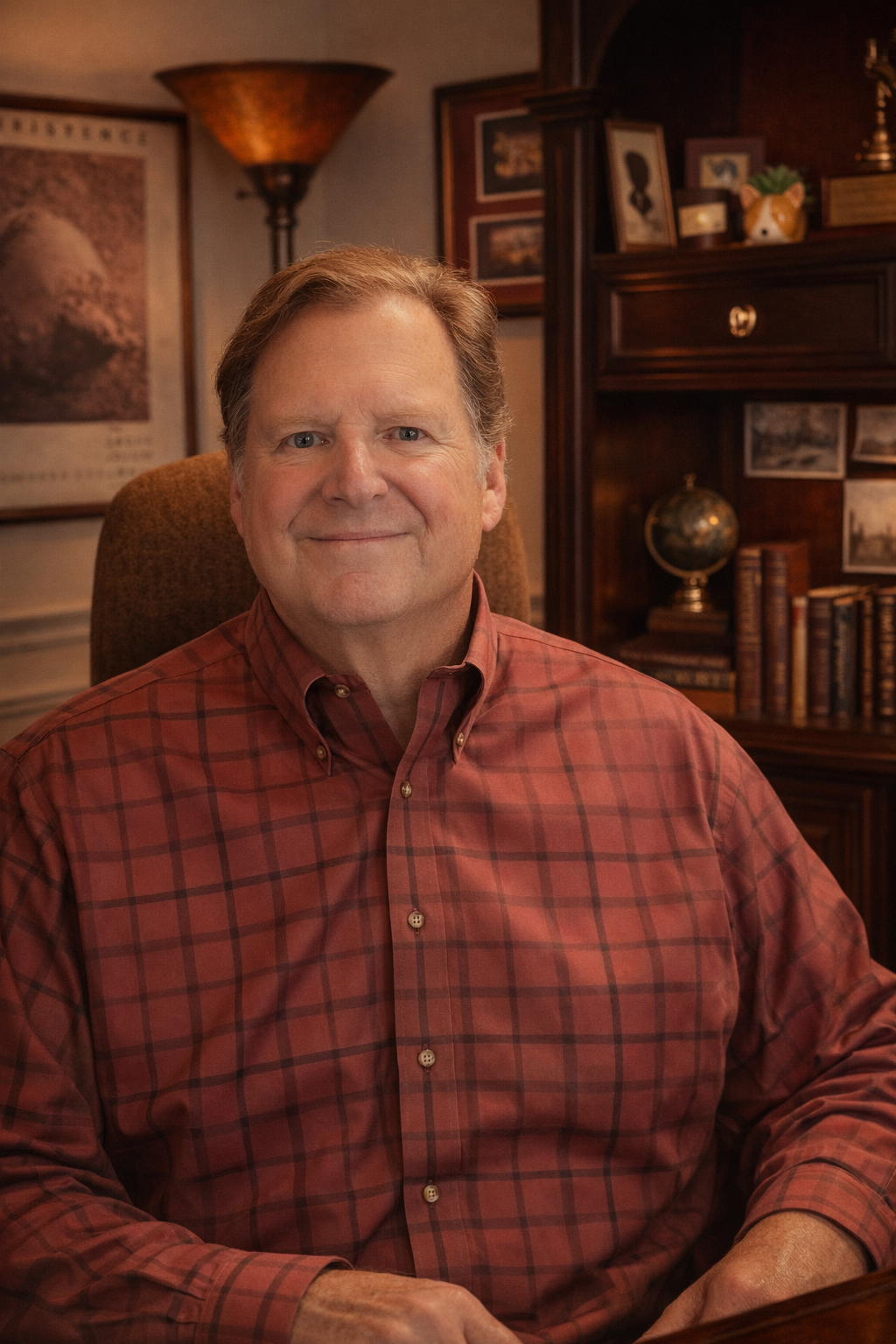
Executive Coach, Author, Woodturner
Chip describes himself simply as a man with a lathe, a pocketknife, and a few stories.
Over the course of a long career in business and coaching, he’s come to see that the moments that shape a life rarely arrive with fanfare. They show up quietly—in family conversations, unexpected detours, and even in a woodshop, shaping a piece of maple.
His work explores how those small moments accumulate over time, changing how we see, how we live, and eventually what we’re willing to let go of.
Those reflections come together in his book, Every Dog Has Its Day, a collection of stories about life, craft, and the decisions that quietly shape who we become.

